Have you ever wondered what keeps your morning toaster glowing cherry-red, or what powers the blistering core of an industrial sintering furnace capable of melting ceramics? Behind almost every electric heating system lies an unsung hero: the resistance heating alloy.
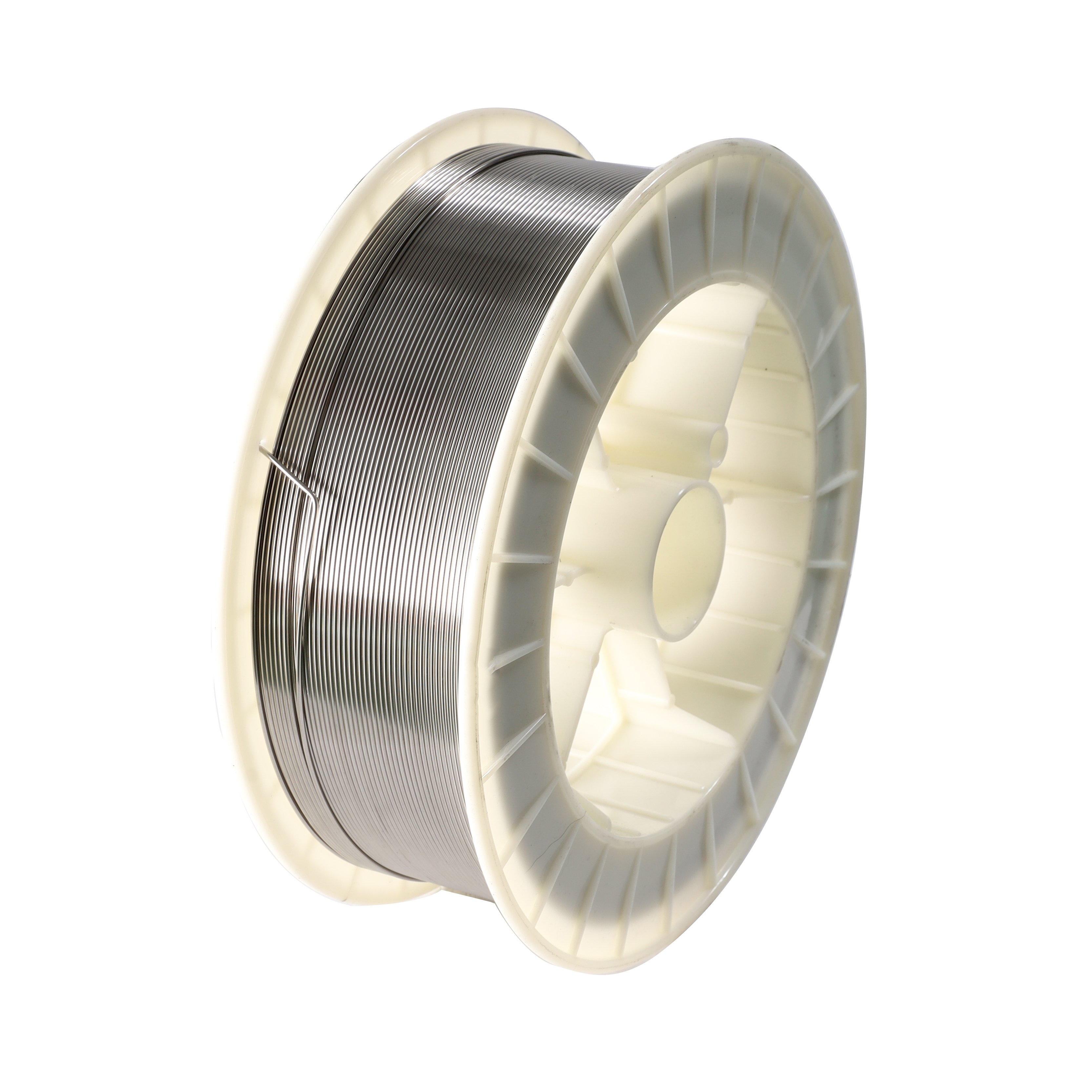
When you push temperatures beyond the comfort zone of ordinary metals, two primary families dominate the playing field: Nichrome (NiCr) and FeCrAl (Iron-Chromium-Aluminum).
Selecting the wrong heating element is like putting bicycle tires on a Formula 1 car—it might roll for a minute, but the moment you demand extreme performance, catastrophic failure is guaranteed. An ill-fitted alloy can deform, oxidize into dust, sag into neighboring coils, or burn out when you least expect it. That translates directly into expensive downtime, wasted power, and ruined production batches.
To make an informed decision, we first need to understand what makes each alloy tick.
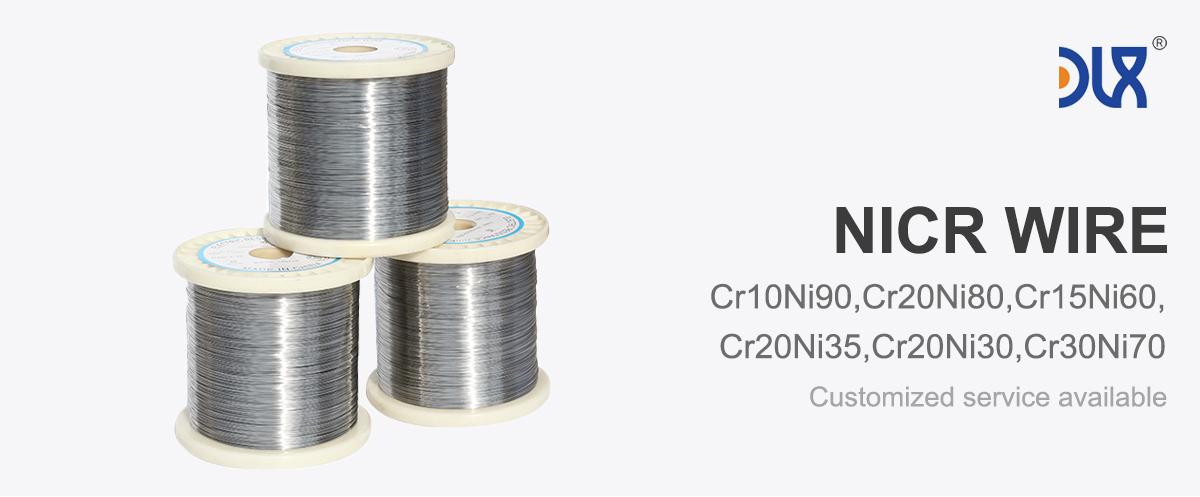
Nichrome is the classic benchmark. Patented in 1906, it is an austenitic alloy typically composed of 80% Nickel and 20% Chromium (such as Ni80Cr20), though variants like Ni60Cr15 exist. It is widely famous for its remarkable mechanical strength, ductility, and dependable corrosion resistance.
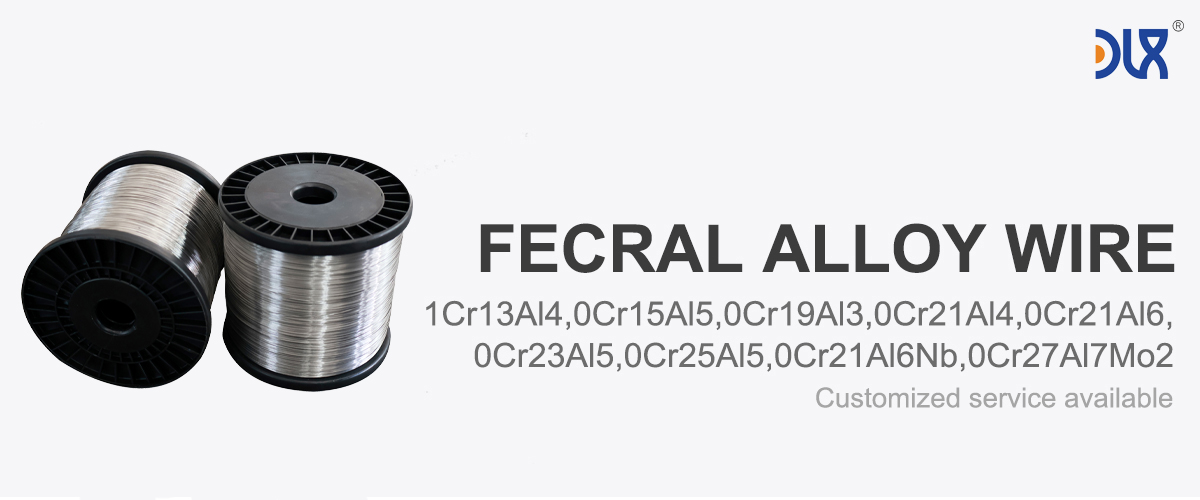
FeCrAl represents modern metallurgical ingenuity. By combining Iron, Chromium (20–24%), and Aluminum (4–6%), this ferritic family—popularly known under trade names like Kanthal—was engineered specifically to break through the temperature ceilings that hold Nichrome back.
The differences in how these materials behave under stress boil down to their atomic structure.
+-------------------------------------------------------------------------+
|                  NICHROME vs FeCrAl: AT A GLANCE                        |
+-------------------------------------------------------------------------+
| Feature              | Nichrome (Ni80Cr20)    | FeCrAl (Kanthal A-1)    |
|----------------------|------------------------|-------------------------|
| Crystal Structure    | Austenitic (FCC)       | Ferritic (BCC)          |
| Max Element Temp     | ~1200°C (2192°F)     | ~1425°C (2597°F)      |
| Density              | ~8.40 g/cm³            | ~7.10 g/cm³             |
| Protective Oxide     | Chromia (Cr2O3)        | Alumina (Al2O3)         |
| Hot Strength / Creep | Superior (Resists Sag) | Moderate (Prone to Sag) |
| Post-Heating Bend    | Remains Ductile        | Becomes Brittle         |
+-------------------------------------------------------------------------+Nichrome’s face-centered cubic (FCC) austenitic crystal structure gives it superb structural stability.
Nickel provides a rock-solid, ductile matrix that resists phase changes even when slammed with thermal shock. Chromium steps up to create a tightly bound surface barrier that stops oxygen from devouring the wire from the inside out.
FeCrAl relies on a body-centered cubic (BCC) ferritic lattice.
While Iron forms the cost-effective backbone, Aluminum is the secret weapon here. When exposed to heat, the aluminum migrates to the outer surface, reacting with oxygen to form a pure layer of Aluminum Oxide (). This alumina shell is an extraordinary thermal and electrical insulator, allowing the alloy to survive conditions that would turn ordinary metals to ash.
How do these materials compare across key engineering dimensions?
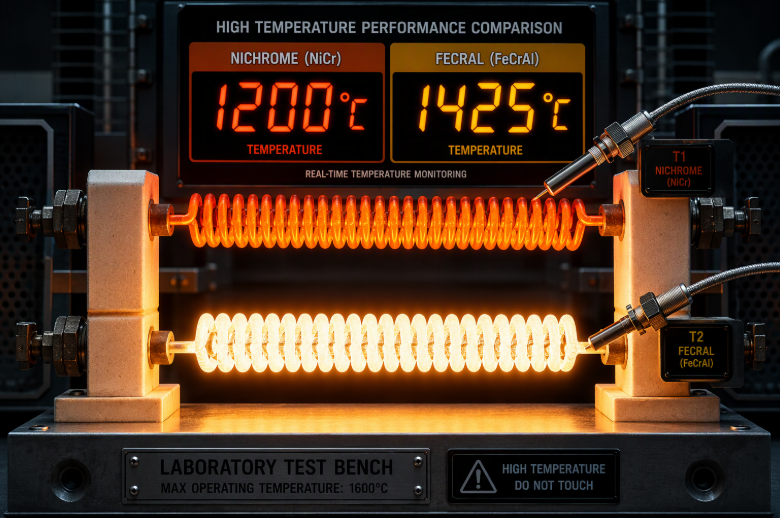
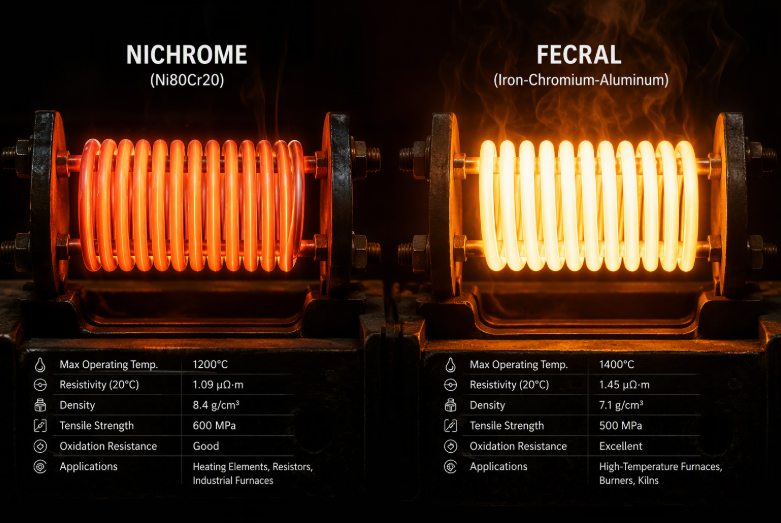
If your application demands raw, blistering heat, maximum continuous operating temperature is your primary filter.
FeCrAl takes the undisputed gold medal in raw temperature threshold. Top-tier FeCrAl grades (such as Kanthal A-1 or 0Cr27Al7Mo2) operate reliably at element temperatures up to 1400°C to 1425°C (2550°F–2600°F).
Standard Ni80Cr20 maxes out around 1150°C to 1200°C (2100°F–2190°F). Push Nichrome past 1200°C, and its protective chromia layer breaks down, causing rapid oxidation and burnout.
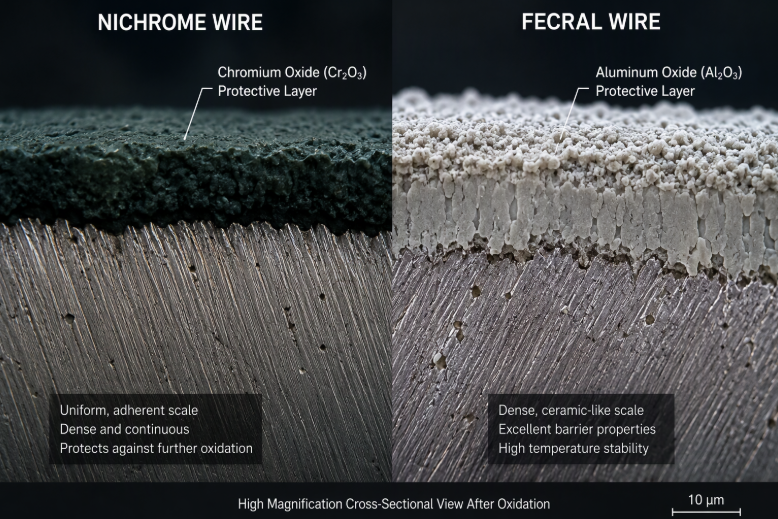
How an alloy protects itself determines how long it survives in harsh environments.
Nichrome forms a dark greenish-black Chromium Oxide scale. What makes chromia special is its mechanical elasticity; it expands and contracts alongside the parent metal. When your equipment cycles on and off repeatedly, Nichrome's oxide scale stays glued to the wire without flaking off into your product.
FeCrAl builds an off-white/light grey Alumina scale. Alumina is chemically more inert than chromia and possesses a higher melting point, offering vastly superior protection at temperatures exceeding 1100°C. However, it is more rigid, requiring careful handling to prevent micro-cracking during rapid thermal swings.
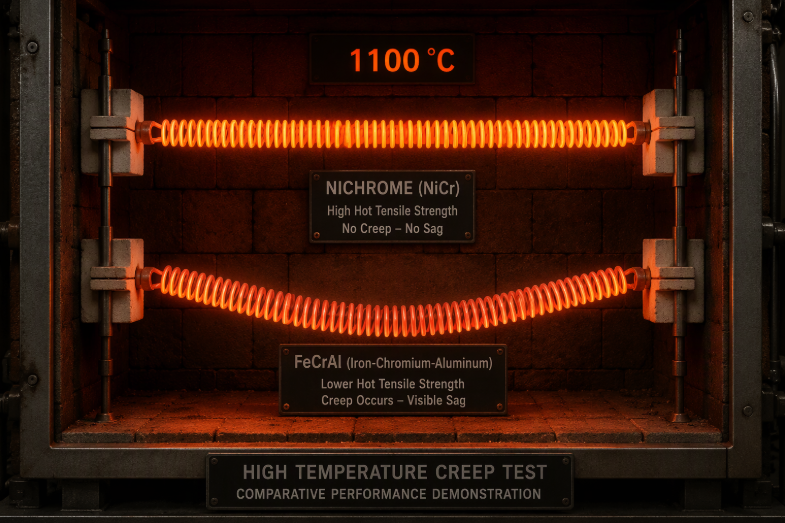
A heating element that cannot support its own weight quickly becomes a fire hazard or short-circuit disaster.
Nichrome shines brightest in mechanical durability. At 1000°C, Nichrome maintains substantial tensile strength. It resists high-temperature creep (the gradual sagging of wire under gravity). Furthermore, even after hundreds of hours of operation, Nichrome remains pliable. You can pull a used element out of a kiln, reshape it cold, and reinstall it without snapping.
FeCrAl suffers from grain growth when exposed to prolonged high heat. Once heated above 950°C and subsequently cooled to room temperature, FeCrAl becomes extremely brittle. If you attempt to bend, stretch, or adjust a used FeCrAl coil, it will snap like dry pasta. Moreover, because of lower hot strength, horizontal FeCrAl elements require comprehensive ceramic support tubes to prevent sagging.
FeCrAl offers an electrical resistivity ranging from 1.25 to 1.45 , which is roughly 15% to 30% higher than Nichrome's 1.05 to 1.12 .
What does this mean for design engineers? A higher resistivity allows you to use a thicker cross-sectional wire to achieve the exact same electrical resistance. Thicker wire translates directly to lower surface watt loading and a substantially longer operating lifespan.
When manufacturing at scale, metal weight directly dictates your bill of materials:
FeCrAl is approximately 15% to 18% lighter than Nichrome. Combined with the fact that FeCrAl is iron-based rather than nickel-based (nickel being a volatile, high-priced commodity), FeCrAl delivers significantly more linear meters of heating wire per kilogram at a noticeably lower price point.
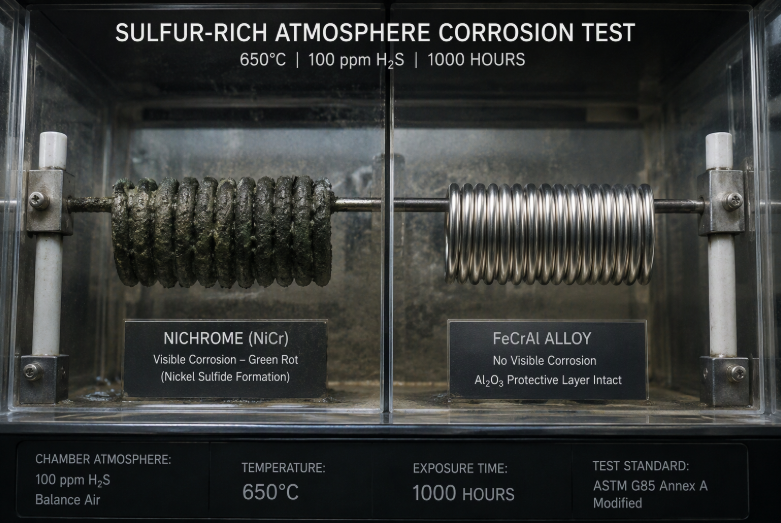
Where will your heating element live? The surrounding atmospheric chemistry can instantly make or break your choice.
Sulfur-Rich Environments: FeCrAl is the clear victor. The alumina surface shell acts as an impenetrable barrier against sulfur compounds. Nichrome, on the other hand, reacts catastrophically with sulfur, creating low-melting-point nickel sulfides that cause rapid intergranular corrosion (known in the industry as "green rot").
Carburizing & Reducing Atmospheres: In vacuum furnaces, nitrogen-rich, or protective reducing atmospheres, Nichrome generally performs more reliably. FeCrAl requires ambient oxygen to regenerate its alumina scale; in oxygen-depleted reducing environments, it can degrade quickly unless pre-oxidized.
Let’s translate these metallurgical characteristics into real-world applications.
Choose Nichrome when mechanical durability, frequent on/off cycling, and complex element shaping take priority:
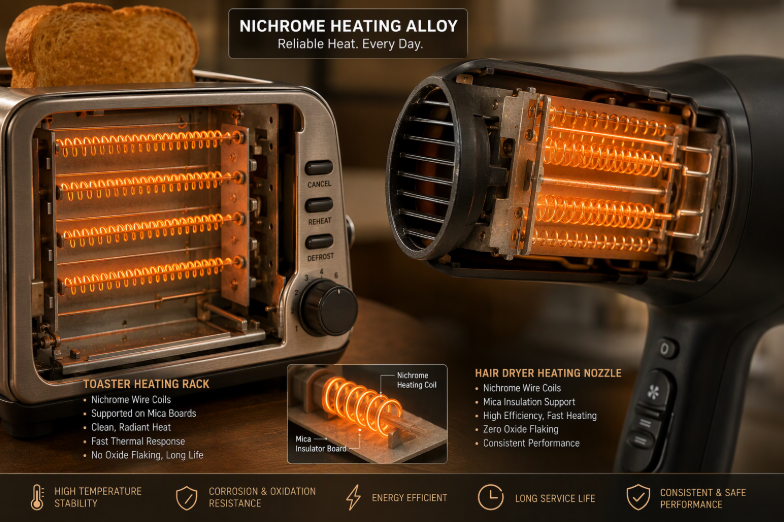
Domestic Appliances: Hair dryers, toasters, space heaters, and clothes dryers.
Precision Equipment: Hot-wire foam cutters, plastic sealers, and laboratory heaters.
Suspended / Unsupported Elements: Open-coil radiant heaters where wires hang freely without continuous ceramic shelving.
Medical & Analytical Devices: Clean environments where flaking oxide scale must be avoided at all costs.
Choose FeCrAl when extreme temperature, high electrical resistance, and cost efficiency are paramount:
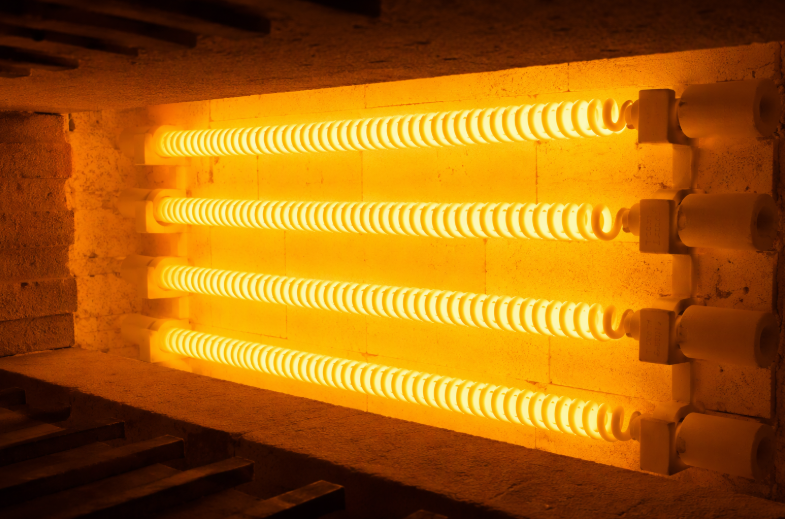
Industrial Kilns & Furnaces: Ceramic firing, glass annealing, and heat-treating furnaces running at 1100°C–1350°C.
Heavy Metallurgy: Sintering and diffusion furnaces operating near maximum limits.
Vaping and Electronic Cigarettes: Coils requiring rapid ramp-up times and high surface resistance.
Continuous High-Heat Systems: Flue gas heaters and industrial drying tunnels.
Use this quick engineering rule-of-thumb:
Is your target element temperature above 1200°C?
Choose FeCrAl. Nichrome cannot survive this zone.
Will the element cycle rapidly on/off, vibrate, or hang unsupported?
Choose Nichrome. Its high hot strength and ductile chromia scale prevent premature structural failure.
Is the environment contaminated with sulfur gases?
Choose FeCrAl. It resists sulfur attack far better than nickel-rich alloys.
Is budget and total component weight your primary design driver?
Choose FeCrAl. Lower density and cheaper raw materials maximize cost-per-watt efficiency.
Does the heating element require post-use maintenance, re-coiling, or physical adjustment?
Choose Nichrome. It will not snap during handling after thermal exposure.
In the showdown between Nichrome and FeCrAl, there is no single universal winner—only the right tool for your specific engineering challenge.
Think of Nichrome as the rugged, dependable workhorse: it bends without breaking, absorbs repeated thermal shocks, resists sagging, and keeps on ticking across millions of everyday appliances. On the flip side, FeCrAl is the high-temperature specialist: lighter, more resistive, budget-friendly, and capable of operating in scorching industrial heat zones where Nichrome would simply melt away.
By carefully evaluating your operating temperature, mechanical layout, atmosphere chemistry, and maintenance expectations, you can lock in the ideal resistance wire and ensure years of uninterrupted thermal performance.
Can you reweld or bend FeCrAl wire after it has been used in a furnace?
No, you should never attempt to bend or mechanically reshape used FeCrAl wire. After operating at high temperatures, FeCrAl develops severe room-temperature brittleness due to grain coarsening. Bending cold, used FeCrAl wire will cause it to snap instantly. If adjustments are mandatory, you must gently heat the wire to a dull red glow (~500°C–600°C) with a torch before applying mechanical force.
Why is FeCrAl generally cheaper than Nichrome?
FeCrAl consists primarily of abundant, low-cost Iron (Fe) mixed with moderate amounts of Chromium and Aluminum. In contrast, Nichrome contains 60% to 80% Nickel (Ni), which is a much more expensive, globally traded base metal subject to higher market volatility. Additionally, FeCrAl's lower density yields more usable wire length per kilogram.
Which alloy is safer for food-contact and domestic appliance heating elements?
Both alloys are non-toxic and widely used in consumer goods, but Nichrome is often preferred for open-element domestic appliances like toasters. Nichrome's tightly adhering chromia scale resists spalling and flaking, ensuring that micro-particles of oxidized metal do not drop into food or cooking chambers during rapid thermal cycling.
Does Nichrome have a longer lifespan than FeCrAl under continuous cycling?
Yes, in rapid on/off cycling below 1100°C, Nichrome frequently outlasts FeCrAl. Nichrome’s chromium oxide scale expands and contracts at a rate similar to the underlying alloy, preventing the protective coating from peeling. In contrast, under continuous, steady-state high heat (>1150°C), FeCrAl’s superior alumina skin provides a significantly longer operational lifespan.
How does element sagging affect furnace design when using FeCrAl?
Because FeCrAl has lower mechanical creep strength at elevated temperatures, horizontal FeCrAl coils will sag under their own weight if left unsupported. Furnace designers must place FeCrAl elements on continuous ceramic trays, embedding grooves, or inside high-alumina support tubes to prevent adjacent coils from touching and short-circuiting.

 EN